
Interest in padel is rising faster than court supply in many parts of the UK. That gap creates funding conversations — from school PE departments to hotel boards and community sports trusts. This guide explains what kinds of money usually exist, who they are for, and how to prepare a case that stands up to scrutiny.
It is not a promise of award. Grant schemes open, close, and change criteria. Treat this as a map of routes, then verify live programmes before you build a cashflow around them.
Who funding is (and is not) for
Unlikely to attract public grant support: private garden and luxury home courts built purely for household use. These are capital projects funded by the owner.
More plausible candidates:
- Community clubs and amateur sports organisations
- Schools and multi-academy trusts
- Local authority leisure portfolios
- Charitable trusts and community interest companies
- Mixed-use schemes with clear public benefit
Commercial operators — clubs, hotels, and private facilities — more often use bank finance, investor equity, landlord contribution, or retained CapEx. Grants may still appear where community access is written into the operating model.

Funders expect a clear need case, realistic costs, and a plan for long-term use.
Common UK funding routes to investigate
Sport England and lottery-linked programmes
Sport England periodically supports facility projects that increase participation, tackle inactivity, or improve community access. Padel can fit where you evidence demand, inclusion, and sustainable operation. Criteria and open windows change — always check current programmes rather than recycled blog lists.
LTA and tennis/padel development support
The Lawn Tennis Association has been active in growing padel alongside tennis. Clubs already in the tennis network are often better placed to hear about court development support, technical guidance, and partnership routes. Affiliation, safeguarding, and venue standards typically sit in the background of any conversation.
Local authority and community funds
Councils sometimes support sports facilities through community grants, infrastructure levies, Section 106-linked contributions, or leisure service capital budgets. Outcomes vary sharply by authority. A project in Hertfordshire will not follow the same path as one in Kent or Essex. Early contact with leisure and planning officers prevents wasted applications.
School and education capital
School padel courts may be funded through school capital programmes, trust-level investment, PTA fundraising, or dual-use agreements with community clubs. Safeguarding, curriculum benefit, and after-hours community access strengthen the case.
Commercial and hybrid finance
Independent clubs and multi-court facilities commonly blend:
- Senior debt or asset finance
- Shareholder / director equity
- Landlord contributions on leased sites
- Soft loans from community foundations
- Phased build programmes that open revenue earlier
Hotels usually treat courts as guest amenity CapEx, sometimes with F&B or membership upsell modelled alongside. See our hotel padel investment and club ROI articles for commercial framing.
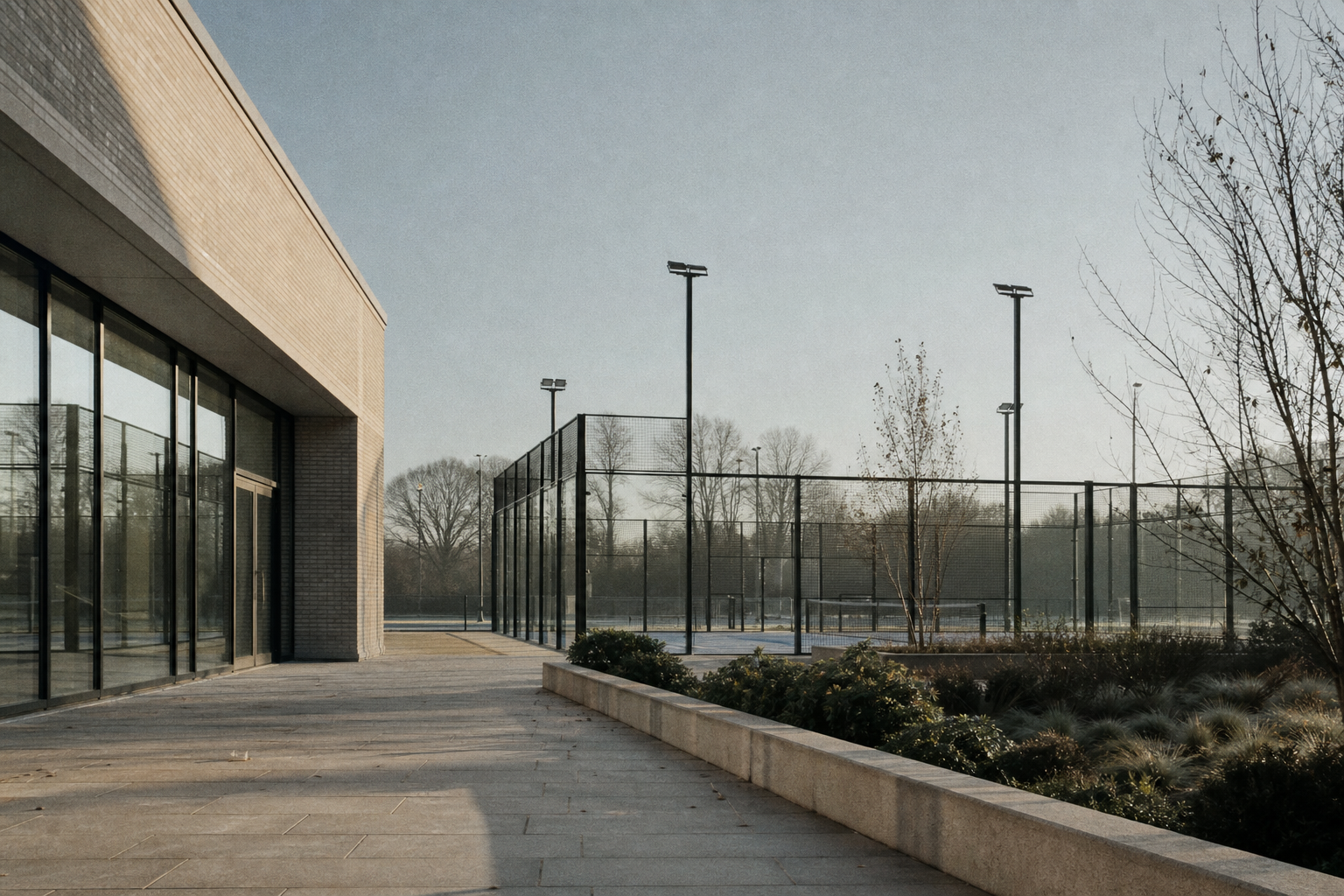
Community and education sites are the most common settings for grant-backed courts.
What funders usually want to see
Strong applications look boring in the best way: clear need, credible costs, and a plan for year five, not only opening day.
Prepare:
- Demand evidence — waiting lists, local court shortages, school participation data
- Site control — freehold, long lease, or landlord consent
- Planning status — permission granted or a realistic pathway (see planning permission guidance)
- Costed specification — civil works, enclosure, lighting, contingency — not a single round number
- Operating model — who runs bookings, maintenance, coaching, and access policies
- Inclusion narrative — how different ages, abilities, and price points are served
- Match funding — most schemes expect you to bring money, not 100% grant cover
A project consultation can help you separate a fundable specification from an aspirational one.
Typical cost reality check
Funders and boards will test whether your number is complete. UK construction commonly lands between £40,000 and £150,000+ per court once foundations, glass, turf, and lighting are included. Sites with poor ground, retaining works, or complex access sit higher.
Under-cooking civil works to fit a grant ceiling is a classic failure mode. It is better to phase courts, simplify lighting, or stage soft landscaping than to delete drainage.
How to sequence funding and construction
Do not order an enclosure on the assumption a grant will arrive next month. A safer sequence:
- Feasibility and site assessment
- Outline specification and budget
- Planning pathway
- Funding applications / board approval
- Detailed design and procurement
- Construction and commissioning
Where programmes have fixed claim deadlines, reverse-plan from those dates and leave float for weather and lead times. Our construction timeline guide helps boards understand why “eight weeks to build” is not the same as “eight weeks to open”.
Practical tips that improve your odds
- Write for a non-padel reader. Many assessors know sports facilities generally, not padel glass heights.
- Show partnership. Schools + clubs, councils + community operators, and hotels + local coaching providers look more resilient.
- Budget maintenance. Annual servicing and turf care belong in the operating plan.
- Be honest about private benefit. If a court is mainly for paying members with limited community access, say so and choose commercial finance instead of stretching a community grant narrative.
- Keep drawings consistent. Conflicting layouts between planning, grant forms, and supplier quotes destroy trust quickly.
Home courts: what owners should do instead
Private homeowners should plan for self-funding, possibly with specialist lending secured against property where appropriate. Time is better spent on planning the project, specifying civil works properly, and avoiding the common construction mistakes that create expensive remediation.
Next step
If you are preparing a board paper, school case, or club funding pack, we can help you put a realistic construction specification and programme underneath the narrative. Request a project consultation — whether your site is in Surrey, Berkshire, or elsewhere in the UK.

