
“How long does it take to build a padel court?” is one of the first questions clients ask — and the honest answer has two clocks. The on-site construction clock can be relatively short. The project clock, which includes planning, procurement, and weather, is what decides when you actually play.
This guide breaks both down for garden padel courts, club, school, and commercial projects in the UK.
The short answer
| Project type | Typical on-site build | Typical full project |
|---|---|---|
| Simple outdoor garden court, level site, planning clear | 2–5 weeks | 8–16 weeks |
| Residential court with planning or access complexity | 3–6 weeks | 3–6 months |
| Single commercial / school / hotel court | 3–7 weeks | 4–7 months |
| Multi-court club facility | Phased weeks–months | 6–12+ months |
These are planning ranges, not guarantees. Ground conditions, manufacturer lead times, and local authority determination can move either end of the scale.
Phase 1: Brief and feasibility (1–3 weeks)
Define use, court count, indoor vs outdoor, and a soft budget. Walk the site for levels, access, and utilities. Decide whether the project is a private amenity or a revenue facility.
Clients who skip this phase often “save” a week and lose a month later when the wrong enclosure is on order. A structured project consultation compresses the uncertainty.
Phase 2: Planning pathway (0–13+ weeks)
If the court sits within a straightforward permitted development interpretation, this phase can be short. If you need a full application — common for commercial use, sensitive residential plots, or schemes with external lighting — build in statutory determination time.
Pre-application advice adds weeks up front and can remove months of redesign later. Pair this article with our planning permission guide and project planning checklist.
Phase 3: Specification and procurement (2–8 weeks)
Manufacturer selection, detailed layout, civil design, and ordering sit here. Glass, steel, and turf are not always ex-stock. Premium systems and busy seasons extend lead times.
Use this window to finalise foundations, drainage, glass walls, turf, and lighting as one coordinated package — not sequential afterthoughts.
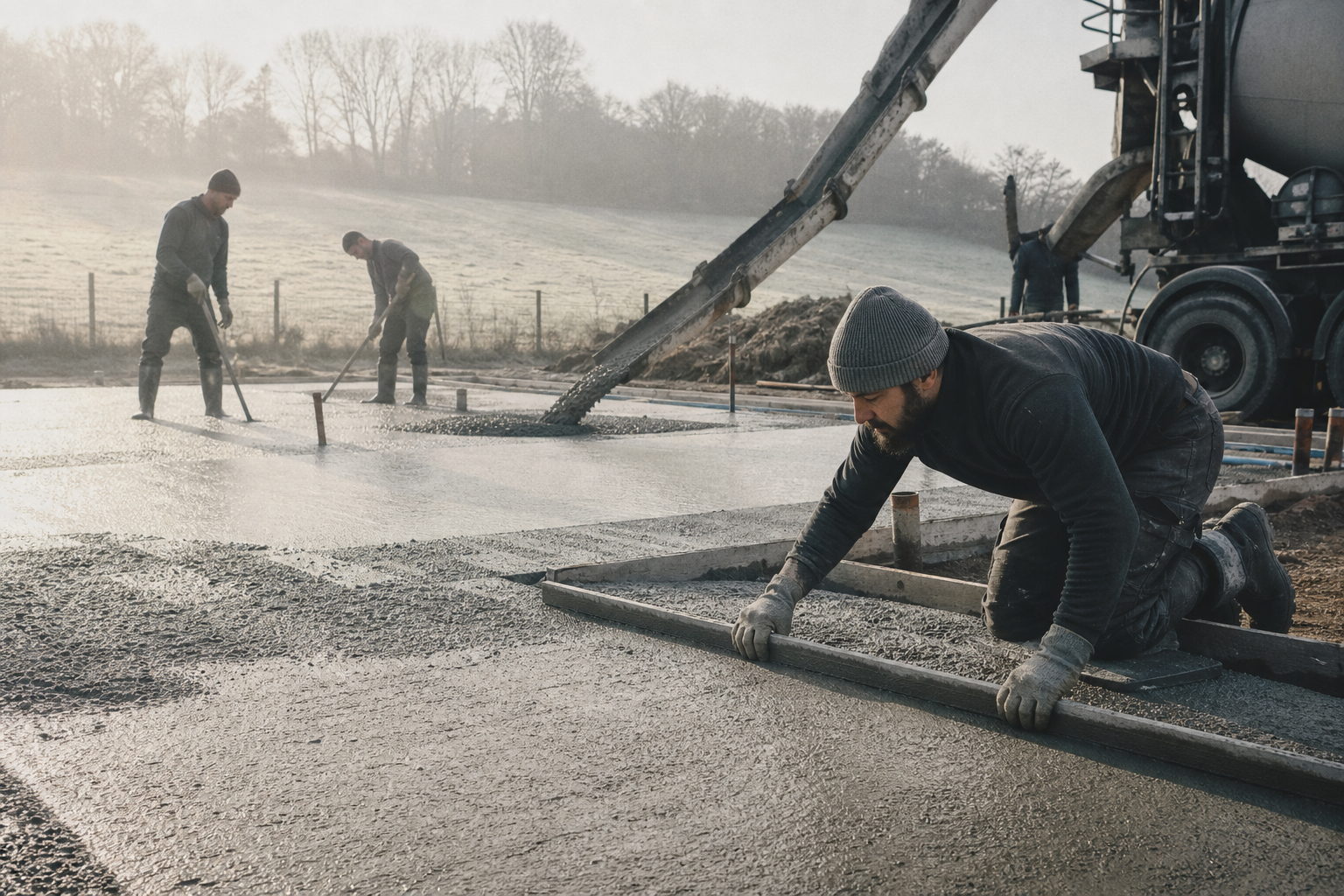
Concrete and curing time often decide the groundworks calendar more than the enclosure install itself.
Phase 4: Groundworks and foundations (1–3 weeks on site, plus curing)
Excavation, sub-base, formwork, reinforcement, pour, and curing dominate the early site programme. Weather matters. A wet fortnight in Essex or Kent clay can pause progress even when the team is ready.
Do not compress curing to chase an opening party. The enclosure depends on a true, stable slab.
Phase 5: Enclosure, turf, and glass (1–2 weeks for a single court)
Once the base is ready and materials are on site, a competent crew can erect steel, glaze, and surface a single outdoor court relatively quickly. Multi-court sites scale with crew size, crane availability, and whether courts are phased for ongoing club operations.
Occupied schools and hotels need longer calendars even when the technical install is unchanged — safeguarding, working hours, and guest operations add friction.
Phase 6: Lighting, fencing, and finishes (concurrent or +3–10 days)
Electrical terminations, luminaire aiming, gates, fencing, and soft landscaping often run alongside or immediately after the enclosure. Consumer unit upgrades on older buildings are a classic hidden delay — survey them in Phase 1.
Phase 7: Commissioning and handover (2–5 days)
Final levels checks, turf grooming, glass clean, lighting tests, warranty registration, and care guidance. Clubs should also align booking systems and operating rules so the court does not open into chaos.
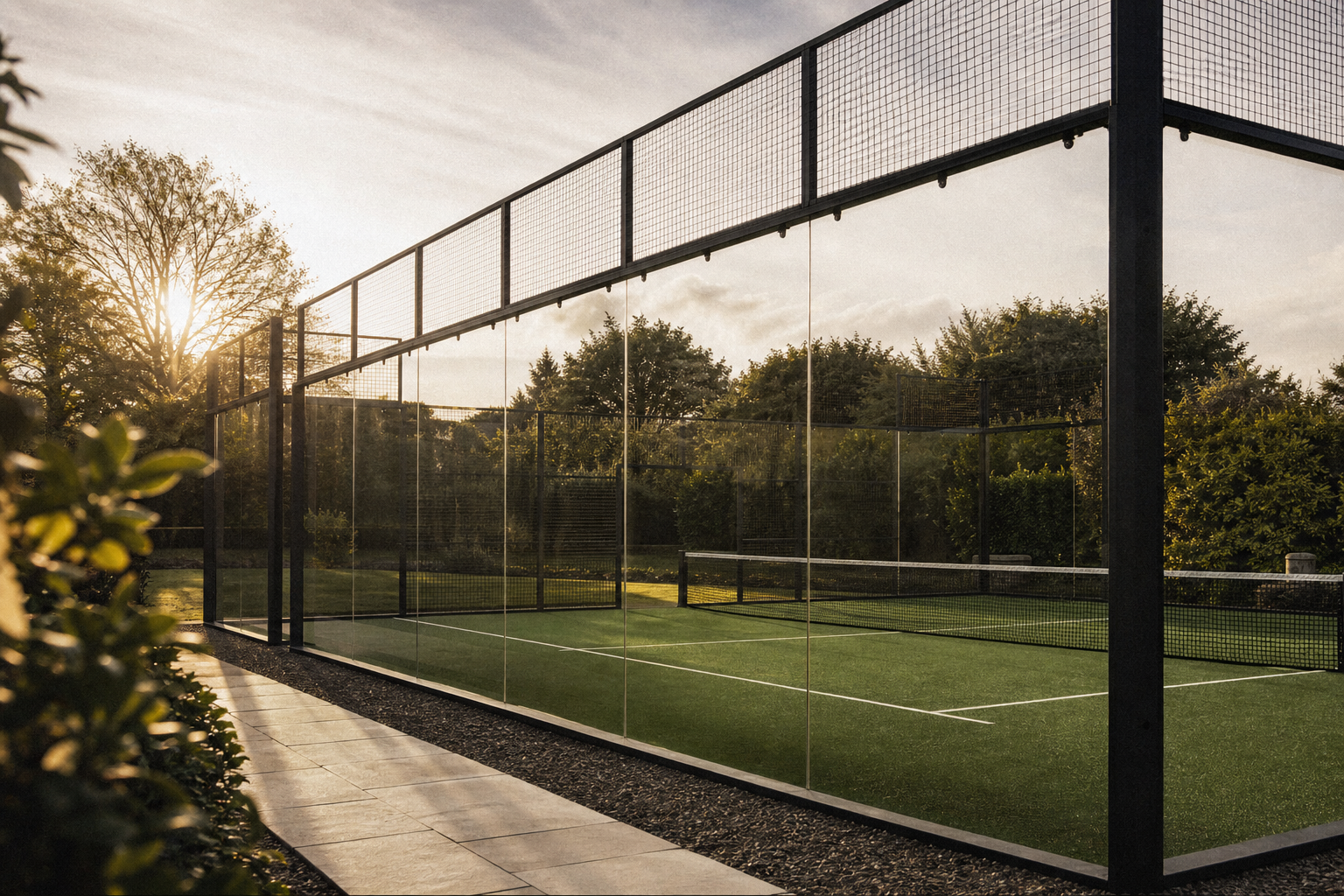
A finished court is the last week of a much longer project calendar.
What usually extends the programme
Planning uncertainty. The single biggest swing factor for residential and commercial schemes alike.
Ground conditions. Retaining walls, imported fill, and deep drainage redesigns add both time and cost.
Access. Narrow gardens in Surrey and Hertfordshire can force staged deliveries and specialised lifting.
Manufacturer lead times. Ordering after you wanted to start on site is how summer openings become autumn openings.
Decision drift. Changing glass height, lighting layout, or court position after drawings are issued resets multiple trades.
Funding gates. Schools and community projects waiting on grant panels should read our grants and funding guide and reverse-plan from claim dates.
Indoor and covered courts take longer
Full indoor builds involve building works beyond the court system — structure, cladding, ventilation, fire strategy, and sometimes change-of-use complexity. Covered outdoor hybrids sit between simple outdoor courts and full indoor projects. See indoor vs outdoor padel courts when you are weighing options.
How to protect your opening date
- Freeze the brief early
- Run planning in parallel with outline specification — not after
- Order long-lead items only when the site and planning path are stable
- Put weather float in the groundworks window
- Avoid value-engineering drainage and steel protection late
- Commission maintenance before marketing launch day
Most of the common construction mistakes that destroy timelines are sequencing errors, not craftsmanship failures.
Home vs commercial expectations
Homeowners often underestimate planning and access, then overestimate how long the glass install itself takes. Commercial operators often underestimate occupied-site logistics and overestimate how quickly stakeholders will approve drawings. Both benefit from a written programme with owners, assumptions, and float visible.
Next step
If you have a target opening date, we can work backwards through planning, procurement, and construction to test whether it is realistic. Request a project consultation or get a construction quote for sites across Berkshire and the wider UK — including garden padel courts, luxury home courts, and multi-court facilities.

